AI Agents in Business: How Companies Can Move From AI Experiments to Real ROI in 2026

AI Agents in Business: How Companies Can Move From AI Experiments to Real ROI in 2026
Artificial Intelligence has moved beyond experimentation. In 2026, businesses are increasingly looking at AI not simply as a technology to explore, but as a tool that should deliver measurable business value.
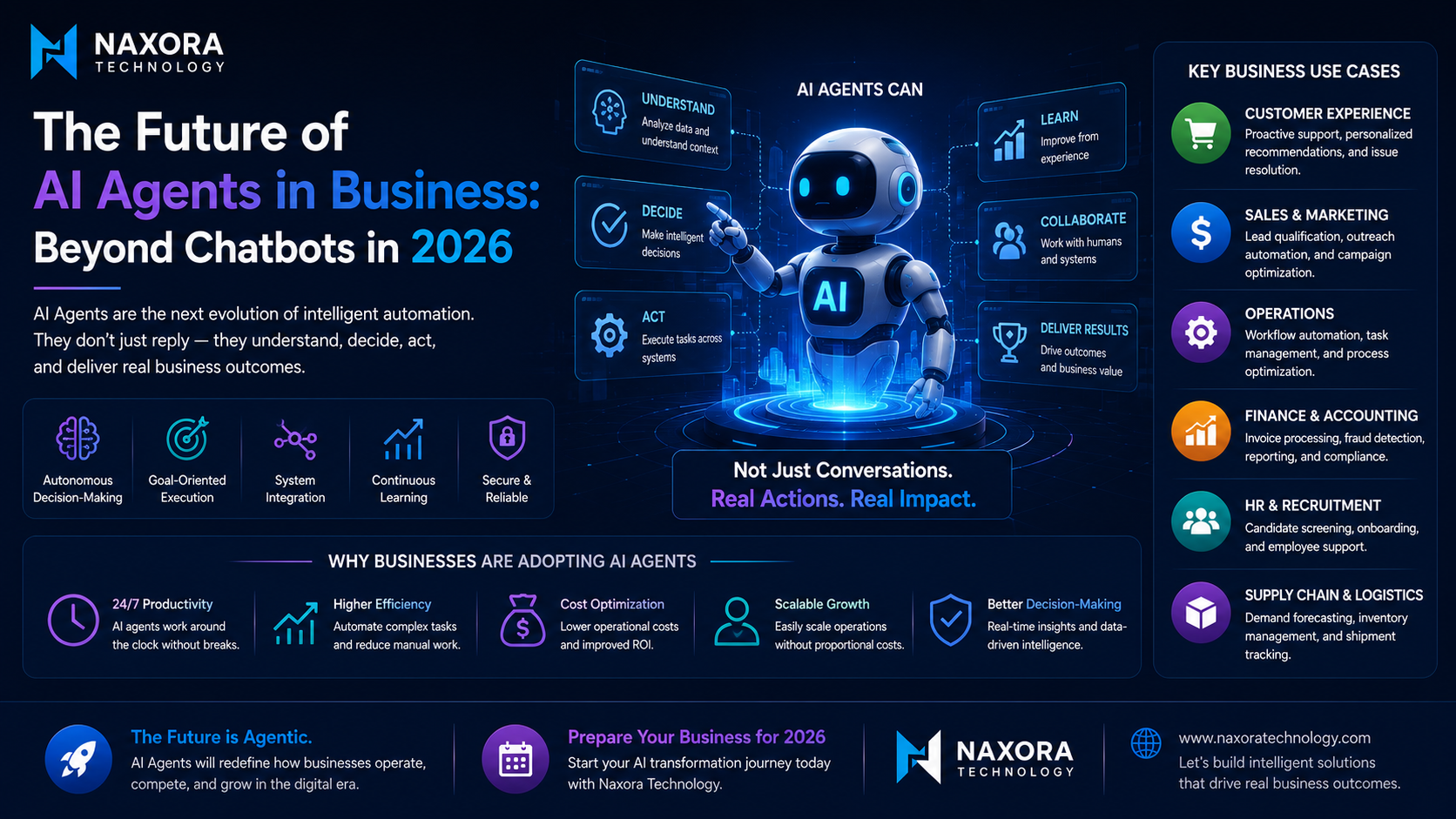
One of the biggest developments is the rise of AI agents. Unlike traditional AI tools that primarily generate content or answer questions, AI agents can work toward defined goals, interact with business systems, execute multi-step workflows, and assist employees with operational tasks.
However, deploying an AI agent does not automatically create business value. Companies need the right use cases, reliable data, secure integrations, clear governance, and measurable success criteria. The real challenge in 2026 is moving from AI experimentation to AI implementation and measurable ROI.
What Are AI Agents?
AI agents are software systems designed to understand goals, reason about tasks, use available tools, and take actions within defined boundaries.
For example, instead of simply answering a customer question, an AI agent could understand the request, check an order management system, retrieve customer information, initiate an approved action, update the CRM, and escalate the issue to a human when necessary.
This ability to connect intelligence with actions makes AI agents particularly valuable for business automation.
Why Businesses Are Moving Beyond AI Experiments
Many organizations began their AI journey with chatbots, content generation, coding assistants, and small proof-of-concept projects. These experiments helped businesses understand what AI could do, but experimentation alone does not create sustainable business value.
The focus is now shifting toward questions such as:
How much time can AI save?
Which business processes can be automated?
Can AI reduce operational costs?
Can AI improve customer experiences?
How should AI performance be measured?
How can AI be deployed securely at scale?
Recent enterprise discussions increasingly emphasize orchestration, governance, and ROI rather than simply choosing the latest AI model. :contentReference[oaicite:1]{index=1}
AI Agents vs Traditional Automation
FeatureTraditional AutomationAI AgentsProcess LogicPredefined rulesGoal-oriented reasoningFlexibilityLimitedHighData UnderstandingStructured dataStructured and unstructured dataDecision SupportRule-basedContext-awareWorkflow ExecutionUsually fixedCan adapt to changing conditionsHuman InteractionLimitedNatural language interaction
Where AI Agents Can Deliver Real Business ROI
1. Customer Support
Customer support is one of the most practical starting points for AI agents. Agents can handle common questions, retrieve customer information, classify support requests, create tickets, and escalate complex issues.
The goal should not simply be to replace human support representatives. Instead, AI agents can handle repetitive work while human teams focus on complex and high-value customer interactions.
2. Sales and Lead Qualification
AI agents can help sales teams identify promising leads, collect information, qualify prospects, update CRM records, schedule meetings, and automate follow-up workflows.
This can reduce administrative work and allow sales teams to spend more time building customer relationships.
3. Business Operations
Operations teams can use AI agents to monitor workflows, generate reports, summarize information, identify exceptions, and coordinate tasks across multiple applications.
4. Finance and Accounting
AI agents can assist with invoice processing, payment reconciliation, expense categorization, financial reporting, and anomaly detection while keeping humans involved in sensitive financial decisions.
5. Internal Employee Support
AI agents can act as internal assistants for HR, IT, finance, and operations teams. Employees can ask questions, retrieve company information, initiate approved workflows, and receive assistance without waiting for another department.
How to Identify a High-ROI AI Use Case
Not every business process needs an AI agent. The best starting point is a workflow where AI can solve a measurable problem.
Look for processes that are:
Repetitive
Time-consuming
High-volume
Based on accessible business data
Currently dependent on multiple manual steps
Easy to measure before and after implementation
For example, reducing the time required to process customer support requests from hours to minutes provides a much clearer ROI measurement than simply saying that an AI system is being used.
How to Measure AI Agent ROI
Businesses should define measurable KPIs before deploying an AI agent.
MetricWhat It MeasuresTime SavedReduction in employee hours spent on repetitive workCost ReductionDecrease in operational expensesResolution TimeHow quickly tasks or customer issues are completedConversion RateImpact on sales or lead generationCustomer SatisfactionImpact on customer experienceTask AccuracyQuality and reliability of automated work
Measuring these outcomes helps businesses determine whether an AI implementation is actually delivering value rather than simply generating activity.
The Hidden Costs of AI Agents
AI ROI is not only about the cost of an AI model. Businesses also need to consider infrastructure, integrations, data preparation, monitoring, security, governance, and ongoing maintenance.
As AI agents move into production, the economics of usage become increasingly important because costs can scale with system activity rather than simply with the number of users. :contentReference[oaicite:2]{index=2}
Why Data Quality Matters
An AI agent can only perform effectively when it has access to reliable and relevant information.
Poor data can result in inaccurate answers, incorrect recommendations, and unreliable workflows. Businesses should therefore invest in data quality, access controls, knowledge management, and clear business context before scaling AI agents.
Current enterprise AI discussions increasingly highlight data readiness and business context as critical factors in moving AI from experimentation into production. :contentReference[oaicite:3]{index=3}
AI Governance and Security
AI agents can interact with business applications and potentially access sensitive information. This makes governance and security essential.
Businesses should implement:
Role-based access controls
Authentication and authorization
Activity logging
Human approval for sensitive actions
Data privacy controls
Continuous monitoring
Clear AI usage policies
Enterprise leaders are increasingly focusing on centralized governance as AI agents scale across departments and platforms. :contentReference[oaicite:4]{index=4}
Start Small, Then Scale
Businesses do not need to transform every department with AI on day one. A better approach is to start with one clearly defined workflow.
Identify a high-value business problem.
Measure the existing process.
Build a small AI agent pilot.
Connect it to the required systems.
Define security and approval boundaries.
Measure the results.
Improve the workflow.
Scale the solution to additional processes.
This approach reduces risk and creates measurable evidence before larger investments are made.
AI Agents and the Future of Business
The future of enterprise AI is increasingly moving toward systems that can coordinate information, tools, workflows, and people. Industry discussions are shifting toward better agents, stronger orchestration, and practical business outcomes rather than simply larger AI models. :contentReference[oaicite:5]{index=5}
This means businesses will need to think about AI as part of their operating model rather than as an isolated software feature.
Why Choose Naxora Technology?
At Naxora Technology, we help businesses turn AI ideas into practical digital solutions. Our services include AI agent development, workflow automation, custom software development, API integration, web applications, mobile applications, and cloud solutions.
We focus on identifying real business problems first and then designing secure, scalable technology around measurable outcomes.
Conclusion
The next phase of business AI is not about running more experiments. It is about building AI systems that solve real problems and deliver measurable results.
AI agents can automate repetitive workflows, improve productivity, support employees, enhance customer experiences, and reduce operational costs. But successful implementation requires more than an AI model. Businesses need reliable data, secure integrations, clear governance, measurable KPIs, and a practical implementation strategy.
Companies that approach AI with a focus on business outcomes, ROI, and responsible deployment will be better positioned to turn AI from an experiment into a genuine competitive advantage.