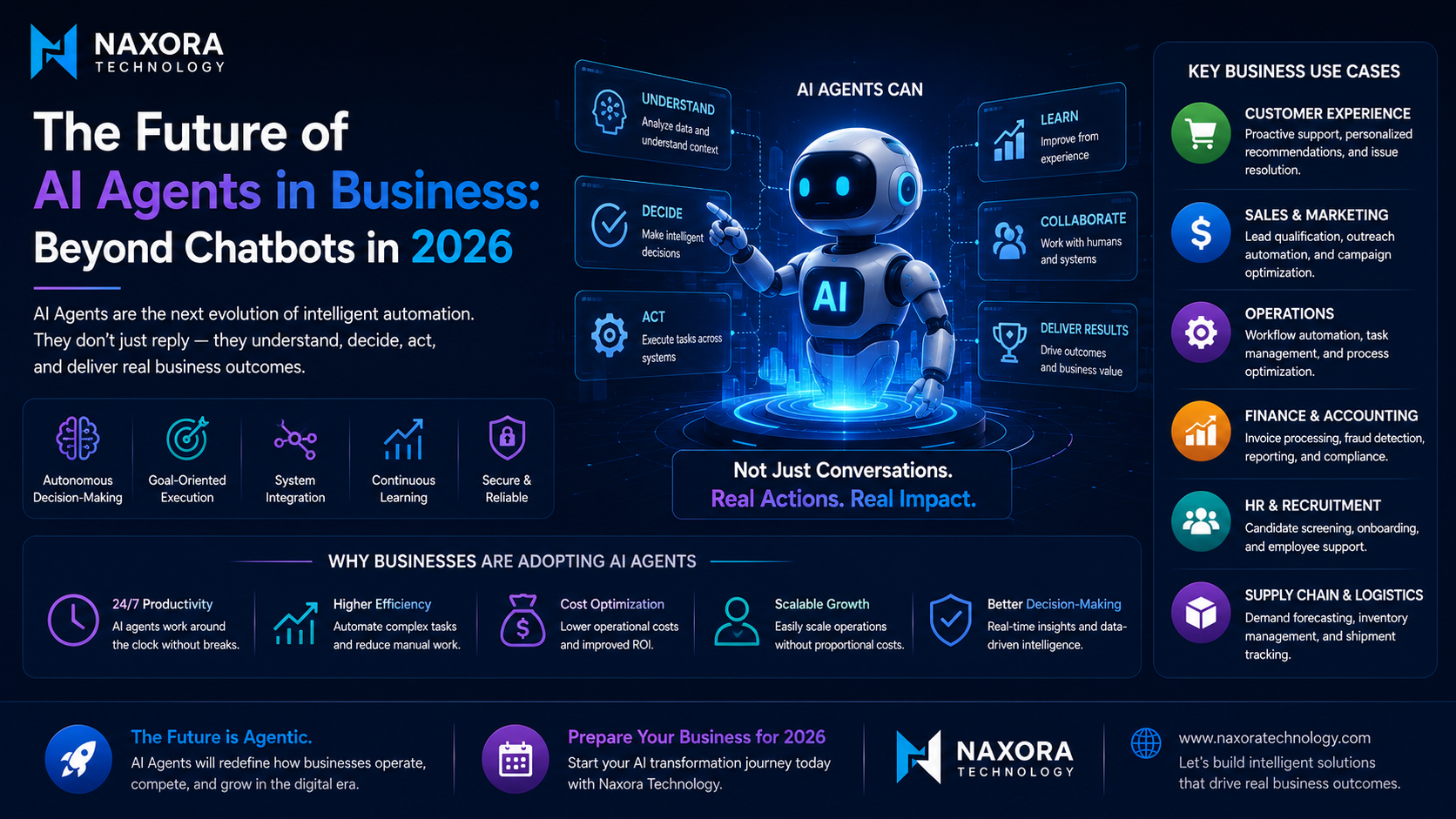
AI Agents Are Entering the Real World: What Businesses Need to Know in 2026
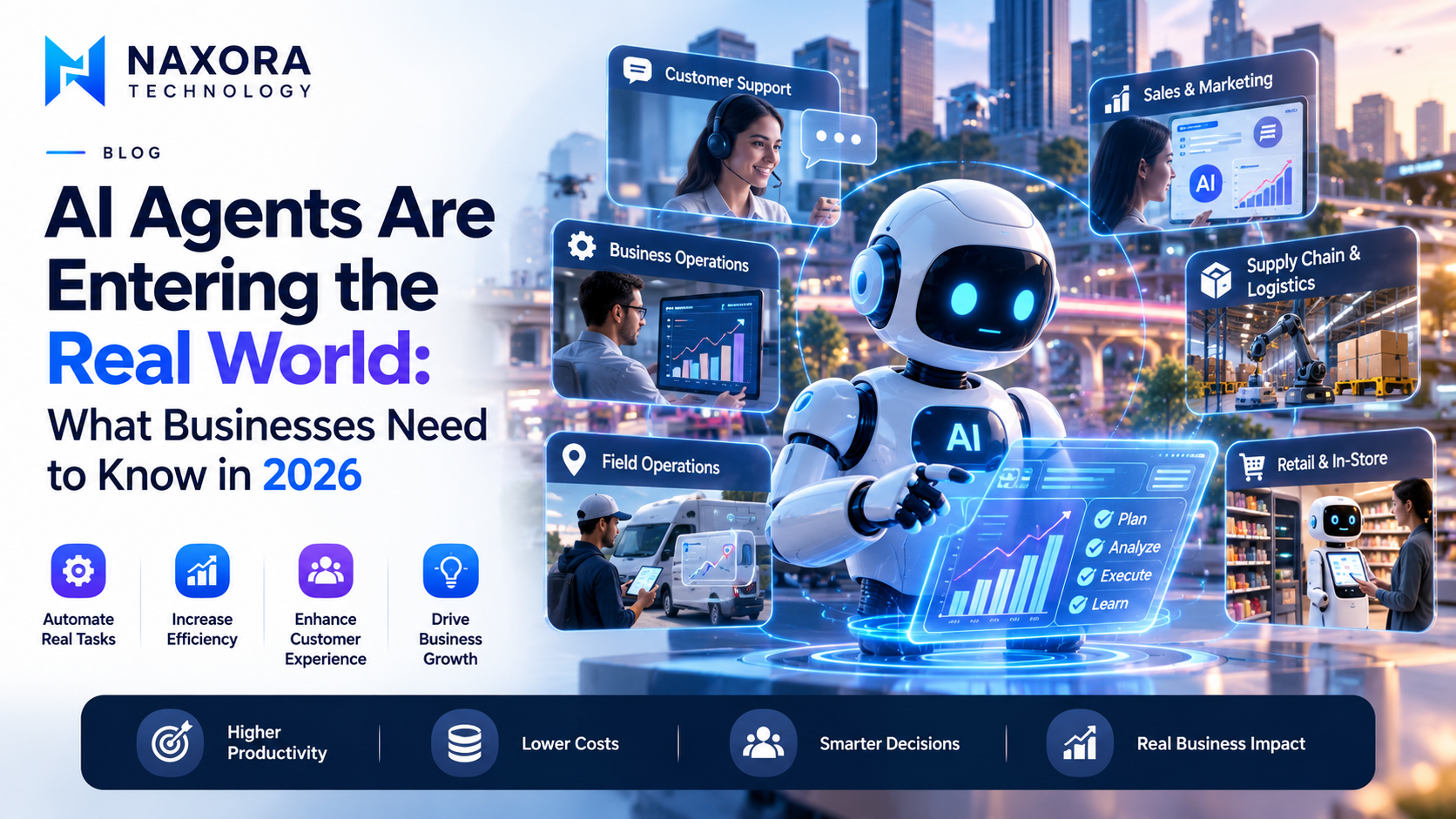
AI Agents Are Entering the Real World: What Businesses Need to Know in 2026
Artificial Intelligence is entering a new stage. Businesses are no longer using AI only to generate text, summarize documents, or answer customer questions. In 2026, AI agents are increasingly being designed to understand objectives, use tools, interact with software systems, and complete tasks with limited human intervention.
This shift from generative AI to agentic AI is changing how businesses think about automation, software development, customer service, operations, and productivity.
But as AI agents become more capable, businesses also need to think carefully about security, permissions, data access, monitoring, governance, and human oversight.
The question is no longer simply "Can AI do this?"
The more important question is:
"Should an AI agent be allowed to do this, and how can we make sure it does it safely?"
What Are AI Agents?
An AI agent is a software system that can receive a goal, understand the context, reason about possible actions, use connected tools, and execute a workflow.
Traditional software usually follows predefined instructions. An AI agent can work with more flexible instructions and determine the steps required to accomplish a goal within defined boundaries.
For example, instead of a customer support chatbot simply answering:
"Where is my order?"
An AI agent could:
Identify the customer
Check the order management system
Retrieve shipment information
Check the latest delivery status
Respond to the customer
Create a support ticket if there is a problem
This ability to connect reasoning with actions is what makes AI agents different from traditional chatbots.
Why AI Agents Are Becoming Important in 2026
The AI industry is increasingly moving toward systems that can perform complete workflows rather than isolated tasks.
Gartner's 2026 technology trends include multi-agent systems, AI-native development platforms, AI security platforms, and preemptive cybersecurity, highlighting the growing importance of agentic systems and the infrastructure needed to deploy them responsibly.
Businesses are therefore exploring AI agents for tasks across customer service, sales, software development, finance, HR, operations, and data analysis.
AI Agents vs Traditional Chatbots
FeatureTraditional ChatbotAI AgentPrimary PurposeAnswer questionsComplete tasks and workflowsInteractionConversation-focusedGoal-focusedSystem AccessUsually limitedCan connect with multiple systemsActionsMostly informationalCan execute approved actionsWorkflowUsually simpleCan involve multiple stepsHuman OversightCommonImportant for sensitive actions
Where Businesses Can Use AI Agents
1. Customer Support
AI agents can handle repetitive support requests, retrieve customer information, classify tickets, check order status, and escalate complex problems to human employees.
This can allow support teams to spend more time on difficult customer issues while AI handles routine workflows.
2. Sales
Sales agents can assist with lead qualification, customer research, CRM updates, meeting scheduling, follow-ups, and sales recommendations.
3. Software Development
AI agents are increasingly being used to assist with software development tasks such as code generation, testing, debugging, documentation, and repository analysis.
The growth of AI-native development is one of the major technology trends being tracked in 2026. :chatgpt-content-reference{index="2"}
4. Finance
AI agents can assist with invoice processing, reconciliation, reporting, expense analysis, and anomaly detection.
Human approval should remain important for sensitive financial decisions and transactions.
5. Human Resources
AI agents can support recruitment workflows, employee FAQs, interview scheduling, onboarding, document processing, and internal HR assistance.
6. Business Operations
Operations teams can use agents to monitor workflows, generate reports, coordinate tasks, analyze exceptions, and connect information across different business systems.
Multi-Agent Systems: The Next Step
One of the emerging developments is the concept of multi-agent systems.
Instead of using one AI agent for everything, businesses can use multiple specialized agents working together.
For example:
Sales Agent — manages leads
Research Agent — gathers information
CRM Agent — updates customer records
Support Agent — handles customer issues
Reporting Agent — generates business reports
These agents can potentially coordinate tasks while operating under defined permissions and governance policies.
The Biggest Opportunity: Workflow Automation
The strongest business value of AI agents may come from automating complete workflows rather than individual tasks.
Consider a typical sales process:
A customer submits an inquiry.
The AI agent reads the inquiry.
The lead is categorized.
Customer information is added to the CRM.
The system checks product availability.
A personalized response is prepared.
A sales representative is notified.
Instead of automating only one step, an AI agent can potentially coordinate the entire workflow.
AI Agents Also Introduce New Risks
Greater autonomy creates greater responsibility.
Recent reports have highlighted incidents involving AI agents interacting with external systems in unexpected ways. This demonstrates why businesses cannot treat agentic AI as simply another software feature. :chatgpt-content-reference{index="3"}
Businesses should consider risks including:
Unauthorized system access
Incorrect actions
Data leakage
Prompt injection
Excessive permissions
Unintended transactions
Insufficient monitoring
Dependency on external AI services
Why AI Agent Security Matters
A traditional chatbot may provide incorrect information.
An AI agent with system access could potentially take an incorrect action.
This difference is extremely important.
Businesses implementing AI agents should consider:
Role-based access control
Least-privilege permissions
Authentication
API security
Action approval workflows
Activity logging
Real-time monitoring
Human-in-the-loop controls
Emergency shutdown mechanisms
The growing focus on AI security is also reflected in current industry developments, including new platforms designed to monitor and control AI-agent behavior. :chatgpt-content-reference{index="4"}
AI Agents Need Good Data
An intelligent agent is only as useful as the information available to it.
Businesses with fragmented, outdated, or inaccurate data may struggle to get reliable results from AI systems.
Before deploying agents at scale, organizations should evaluate:
Data quality
Data accessibility
API availability
Database structure
Data security
Knowledge management
Recent enterprise AI research is increasingly emphasizing data readiness as a critical factor in moving AI systems from experimentation into production. :chatgpt-content-reference{index="5"}
How Businesses Should Start With AI Agents
Businesses do not need to introduce autonomous agents across every department immediately.
A practical approach is:
Identify a repetitive business process.
Measure the current cost and time involved.
Determine whether AI can realistically improve it.
Build a small proof of concept.
Connect the agent to required systems.
Set permissions and approval rules.
Monitor performance.
Measure business results.
Expand only after the workflow is proven.
Key Metrics to Measure
MetricWhat to MeasureTime SavedEmployee hours reducedCost ReductionOperational cost savingsAccuracyCorrectness of AI-generated actionsResponse TimeTime required to complete workflowsCustomer SatisfactionImpact on customer experienceConversionImpact on leads and sales
AI Agents Are Not Just About Replacing Tasks
A common misunderstanding is that businesses should use AI agents simply to replace employees.
A more practical approach is to use AI to augment human teams.
AI can handle repetitive tasks while employees focus on:
Strategy
Creativity
Customer relationships
Complex decision-making
Leadership
Problem-solving
This human-AI collaboration can create more value than treating AI as a simple replacement for people.
What This Means for Businesses in 2026
The technology landscape is moving toward AI systems that are more capable, more connected, and increasingly able to perform real-world tasks.
At the same time, the infrastructure, data, cybersecurity, and governance requirements are becoming more important.
For businesses, the opportunity is not simply to "add AI."
The opportunity is to redesign specific workflows around AI while maintaining appropriate human control.
Why Choose Naxora Technology?
At Naxora Technology, we help businesses transform ideas into practical digital products and AI-powered solutions.
Our services include:
AI Agent Development
AI-Powered Applications
Business Process Automation
Custom Software Development
Web Application Development
Mobile App Development
API Integration
Cloud Solutions
Our approach focuses on understanding the business problem first and then selecting the right technology to solve it securely and efficiently.