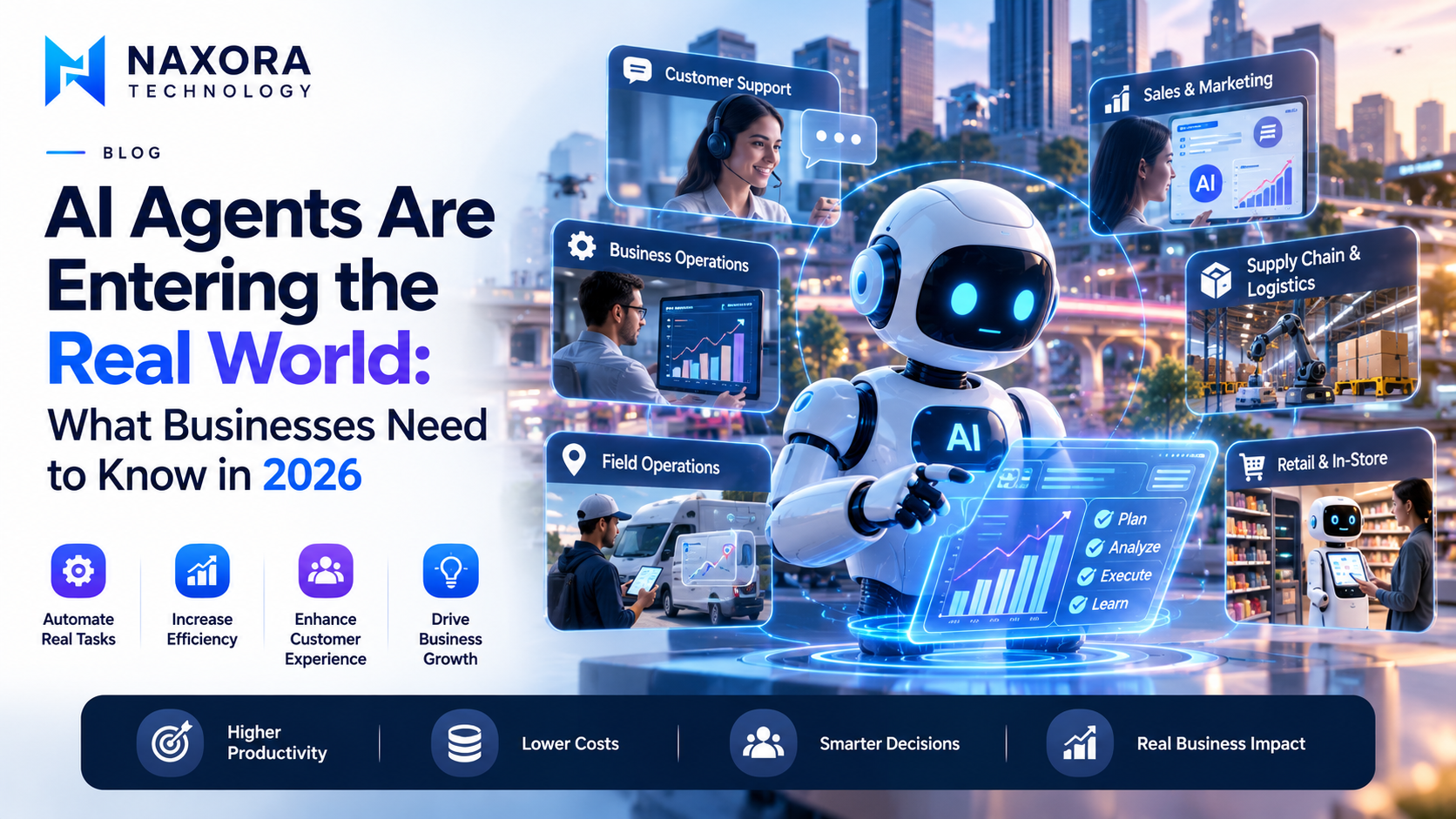
The Future of AI Agents in Business: Beyond Chatbots in 2026
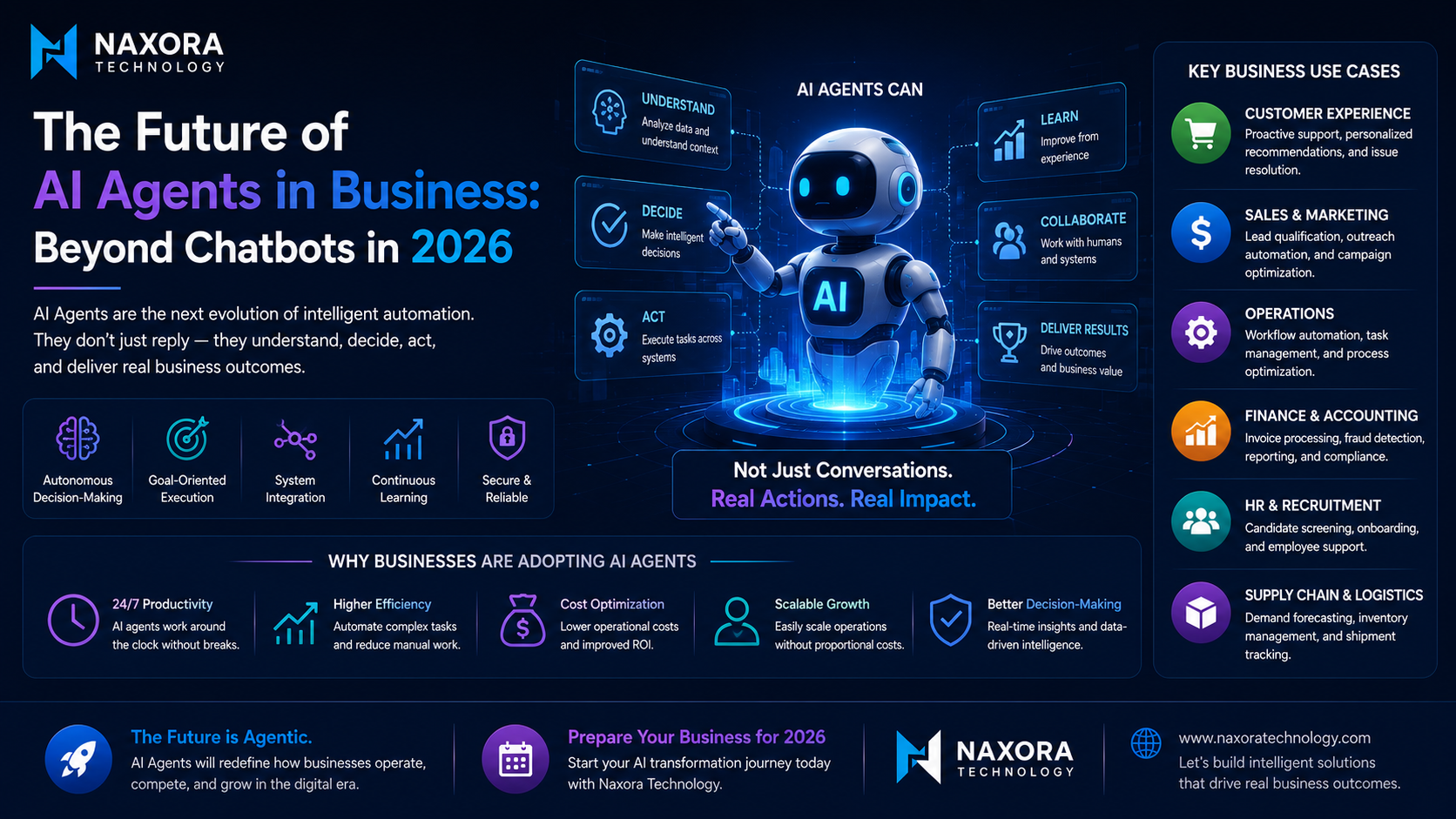
The Future of AI Agents in Business: Beyond Chatbots in 2026
Artificial Intelligence has rapidly evolved from simple automation tools to intelligent systems capable of reasoning, planning, and completing complex tasks. In 2026, businesses are moving beyond traditional chatbots and embracing AI Agents—autonomous digital assistants that can perform multi-step workflows, collaborate with employees, and make context-aware decisions.
Unlike conventional chatbots that respond to predefined queries, AI agents can understand goals, interact with multiple business systems, analyze data, and execute actions with minimal human intervention. This shift is transforming how organizations operate, improving productivity, reducing operational costs, and delivering better customer experiences.
Whether you're a startup, SME, or enterprise, understanding the role of AI agents is essential for staying competitive in today's digital landscape.
What Are AI Agents?
An AI agent is an intelligent software system that can perceive information, reason about tasks, make decisions within defined boundaries, and take actions to achieve specific goals.
Unlike traditional automation, AI agents can:
Understand natural language instructions
Plan and execute multi-step tasks
Access business applications through APIs
Learn from previous interactions
Provide recommendations based on real-time data
Work independently while keeping humans in control of important decisions
AI Agents vs Traditional Chatbots
FeatureTraditional ChatbotsAI AgentsPurposeAnswer predefined questionsComplete complex tasks and workflowsDecision MakingRule-basedContext-aware and goal-orientedLearning AbilityLimitedContinuously improves with data and feedbackSystem IntegrationBasicWorks across multiple business systemsAutomationSingle-stepMulti-step autonomous workflowsBusiness ValueCustomer supportOrganization-wide productivity
Why Businesses Are Investing in AI Agents
Organizations are adopting AI agents because they help teams accomplish more without increasing operational complexity.
Key benefits include:
Higher employee productivity
Reduced manual work
Faster customer response times
Improved decision-making
24/7 business operations
Lower operational costs
Better customer experiences
Real-World Business Applications
1. Customer Support
AI agents can answer customer queries, process refunds, schedule appointments, escalate complex issues, and provide personalized recommendations—all without requiring constant human intervention.
2. Sales and Lead Management
Sales teams use AI agents to qualify leads, schedule meetings, update CRM systems, send follow-up emails, and recommend the next best action based on customer behavior.
3. HR and Recruitment
Human resource teams benefit from AI agents that screen resumes, answer employee questions, schedule interviews, manage onboarding tasks, and automate routine administrative work.
4. Finance and Accounting
AI agents help process invoices, reconcile transactions, detect anomalies, generate financial reports, and monitor spending patterns.
5. Healthcare
Healthcare providers use AI agents for appointment scheduling, patient communication, medical record management, and operational support while maintaining human oversight for clinical decisions.
6. Logistics and Supply Chain
AI agents analyze inventory levels, optimize delivery routes, monitor shipments, and forecast demand to improve operational efficiency.
How AI Agents Improve Productivity
Business FunctionHow AI Agents HelpCustomer ServiceInstant responses and ticket resolutionSalesLead qualification and CRM updatesMarketingCampaign insights and content assistanceOperationsWorkflow automation and reportingFinanceInvoice processing and reconciliationHRRecruitment and employee support
Technologies Powering AI Agents
Modern AI agents combine multiple technologies to perform intelligent tasks.
Large Language Models (LLMs)
Natural Language Processing (NLP)
Machine Learning
Retrieval-Augmented Generation (RAG)
Workflow Automation Platforms
API Integrations
Cloud Computing
Vector Databases
Challenges Businesses Should Consider
While AI agents offer significant advantages, successful implementation requires careful planning.
Protect sensitive business data
Define clear permissions and access controls
Ensure compliance with privacy regulations
Monitor AI decisions for accuracy
Maintain human oversight for critical processes
Train employees to work effectively alongside AI systems
Best Practices for Implementing AI Agents
Identify repetitive and time-consuming workflows.
Start with a pilot project.
Integrate AI agents with existing business systems.
Set measurable success metrics.
Monitor performance and continuously improve workflows.
Prioritize security, privacy, and governance.
Keep humans involved in high-impact decisions.
Future Trends in AI Agents
The capabilities of AI agents are expected to expand significantly over the coming years. Businesses can expect:
Teams of AI agents collaborating on complex projects
Greater personalization through customer context
Deeper integration with enterprise software
Voice-enabled business assistants
Smarter predictive decision support
Industry-specific AI agents for healthcare, finance, education, manufacturing, and logistics
Organizations that prepare for these advancements today will be better positioned to adapt and innovate in the future.
Why Choose Naxora Technology?
At Naxora Technology, we help businesses build intelligent AI-powered solutions tailored to their unique requirements. Our expertise includes AI agents, workflow automation, custom software development, web and mobile applications, cloud integration, API development, and scalable enterprise solutions.
We focus on creating secure, reliable, and future-ready systems that improve efficiency while delivering measurable business value.
Conclusion
AI agents represent the next stage in business automation. Unlike traditional chatbots, they can understand objectives, execute multi-step workflows, integrate with business systems, and support employees across departments.
As organizations continue to embrace digital transformation, AI agents will become an essential part of modern business operations. Companies that adopt these technologies strategically can improve productivity, enhance customer experiences, and build a stronger competitive advantage.