Cloud Migration vs Cloud Modernization: What's the Difference?
Cloud Migration vs Cloud Modernization: What's the Difference?
Cloud technology has become the backbone of modern digital businesses. Organizations of every size are moving away from traditional on-premises infrastructure to improve scalability, reduce costs, and support innovation. However, many businesses confuse Cloud Migration with Cloud Modernization.
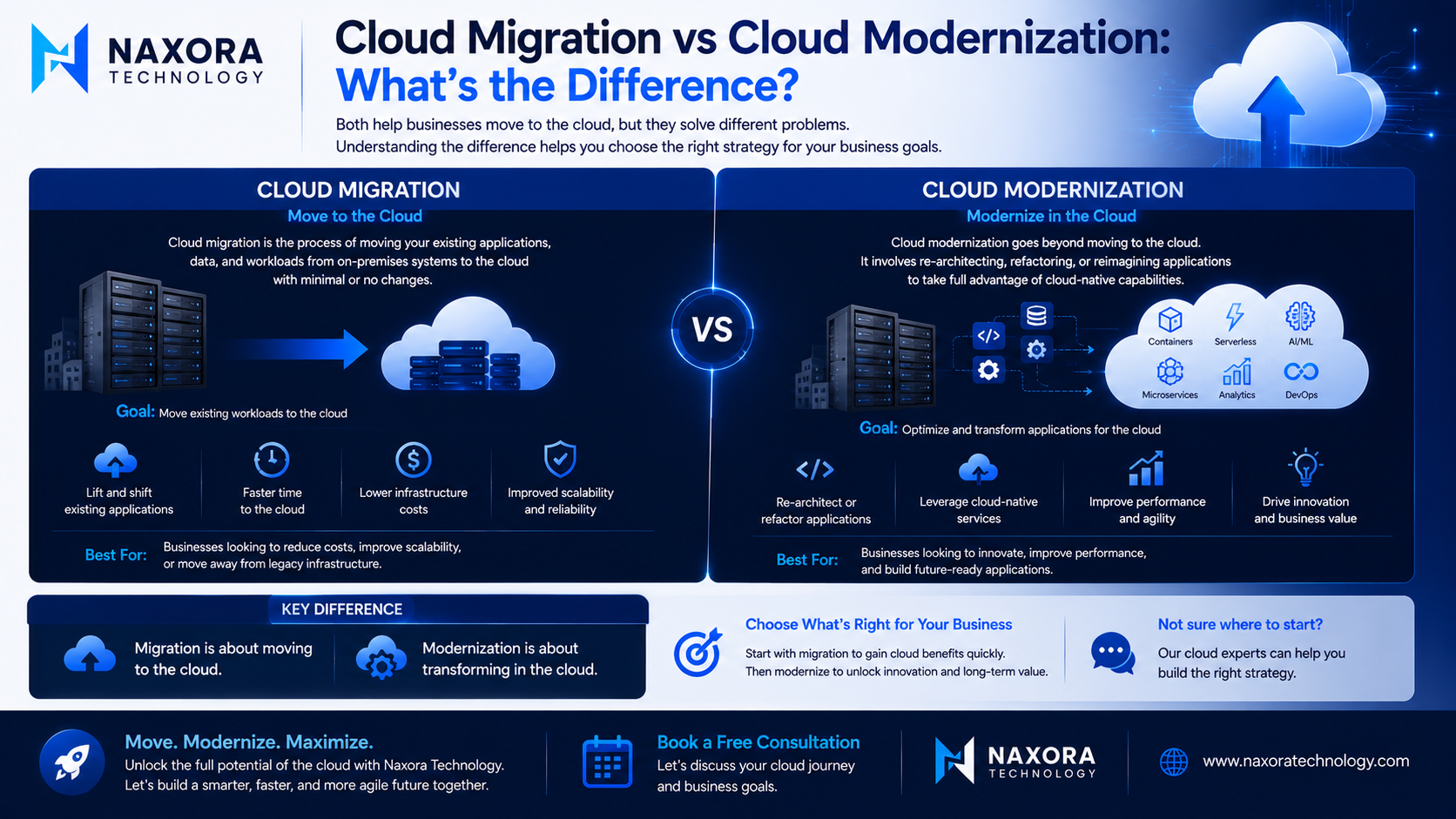
Although both strategies involve cloud computing, they serve different purposes. Cloud migration focuses on moving existing applications and data to the cloud, while cloud modernization transforms applications to fully utilize cloud-native technologies.
Understanding the difference helps businesses choose the right strategy for long-term success and maximize their return on investment.
What Is Cloud Migration?
Cloud migration is the process of moving applications, databases, workloads, and IT infrastructure from on-premises servers or legacy systems to a cloud environment.
The primary objective is to relocate existing systems with minimal changes while improving accessibility, reliability, and infrastructure management.
Common Cloud Migration Approaches
Rehosting (Lift and Shift): Move applications without significant changes.
Replatforming: Make minor optimizations before moving to the cloud.
Refactoring: Modify parts of the application to improve cloud compatibility.
What Is Cloud Modernization?
Cloud modernization goes beyond simply moving applications to the cloud. It involves redesigning, rebuilding, or optimizing applications to leverage cloud-native technologies such as containers, microservices, serverless computing, and managed cloud services.
The goal is to improve performance, scalability, security, and operational efficiency while preparing applications for future business growth.
Cloud Migration vs Cloud Modernization
FeatureCloud MigrationCloud ModernizationPrimary GoalMove existing systems to the cloudOptimize applications for cloud-native environmentsApplication ChangesMinimalSignificant improvementsDeployment SpeedFastLonger implementationScalabilityImprovedHighly scalablePerformanceModerate improvementMaximum performanceLong-Term ValueGoodExcellentInfrastructure CostsReducedOptimized further
Benefits of Cloud Migration
Lower infrastructure costs
Reduced hardware maintenance
Improved disaster recovery
Remote accessibility
Business continuity
Faster deployment
Better data availability
Benefits of Cloud Modernization
Cloud-native scalability
Improved application performance
Higher security standards
Automatic resource scaling
Faster software releases
Improved customer experience
Better system reliability
Long-term operational savings
When Should You Choose Cloud Migration?
Cloud migration is ideal if your business wants to quickly move away from on-premises infrastructure without redesigning existing applications.
Choose cloud migration when:
Your infrastructure is aging.
You need remote access for employees.
You want to reduce hardware investments.
Your applications already perform well.
You need a faster cloud adoption strategy.
When Should You Choose Cloud Modernization?
Cloud modernization is the better choice if you're planning long-term digital transformation or your existing applications are limiting business growth.
Modernization is recommended when:
Your applications are difficult to maintain.
You experience scalability issues.
You need higher performance.
You want to integrate AI and automation.
You require faster feature deployment.
You plan to support rapid business growth.
Real-World Example
Cloud Migration
A retail company moves its existing ERP system from an on-premises server to a cloud virtual machine without changing the application's architecture.
The company immediately benefits from lower infrastructure costs and improved accessibility.
Cloud Modernization
The same retailer later rebuilds the ERP into microservices, introduces API integrations, automates inventory management, and deploys serverless functions for peak shopping seasons.
The result is a faster, more scalable, and future-ready platform.
Common Challenges
ChallengeMigrationModernizationDowntime Planning✓✓Application Compatibility✓✓Development ComplexityLowHighTesting RequirementsMediumHighInitial InvestmentLowerHigher
Best Practices for a Successful Cloud Strategy
Assess your current infrastructure.
Define clear business objectives.
Choose the right cloud provider.
Prioritize security and compliance.
Optimize application architecture.
Implement continuous monitoring.
Train employees on cloud technologies.
Work with experienced cloud professionals.
How Cloud Supports Digital Transformation
Cloud technologies enable organizations to innovate faster, improve collaboration, reduce operational costs, and deploy applications globally.
Combined with modern technologies such as Artificial Intelligence, API integration, automation, and data analytics, cloud platforms provide the flexibility businesses need to remain competitive.
Why Choose Naxora Technology?
At Naxora Technology, we help businesses successfully migrate, modernize, and optimize their cloud infrastructure. Our team designs scalable cloud architectures, modernizes legacy applications, develops cloud-native software, and implements secure cloud solutions tailored to your business objectives.
Whether you're beginning your cloud journey or modernizing existing applications, we provide end-to-end cloud consulting and development services.
Conclusion
Cloud migration and cloud modernization are both valuable strategies, but they solve different business challenges.
If your goal is to move existing systems to the cloud quickly, migration is the right choice. If you want to unlock the full potential of cloud computing with scalable, secure, and high-performance applications, modernization offers greater long-term value.
Choosing the right approach depends on your current infrastructure, business goals, budget, and future growth plans.
Ready to Accelerate Your Cloud Journey?
If you're planning to migrate to the cloud or modernize your existing applications, Naxora Technology can help you build secure, scalable, and future-ready cloud solutions that support long-term business growth.