Top Software Development Trends Every Business Should Know in 2026
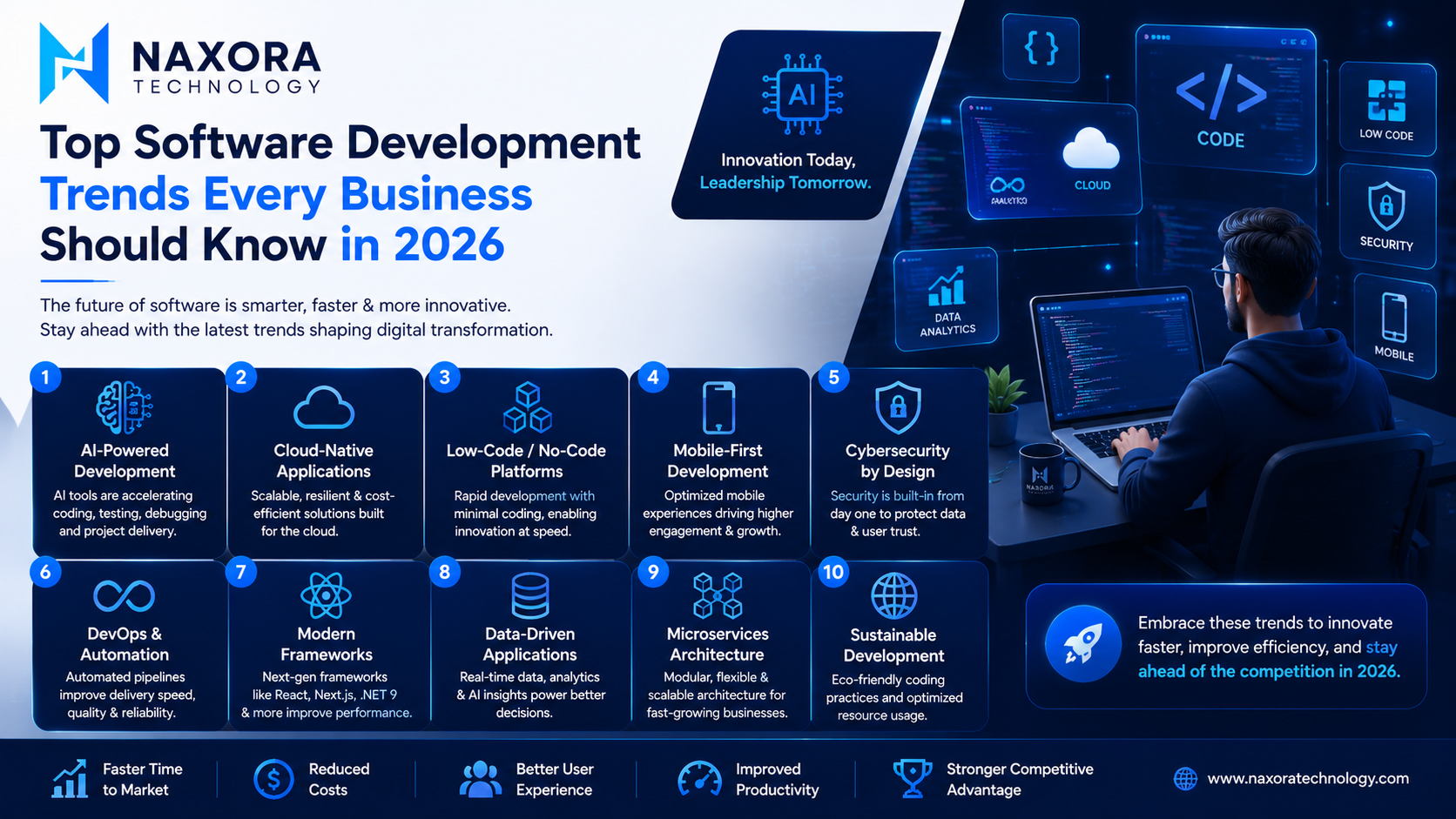
Top Software Development Trends Every Business Should Know in 2026
The software industry continues to evolve rapidly as businesses embrace new technologies to improve efficiency, enhance customer experiences, and stay ahead of the competition. In 2026, software development is no longer just about writing code—it's about building intelligent, scalable, secure, and future-ready digital solutions.
Whether you're a startup, SME, or enterprise, understanding the latest software development trends can help you make smarter technology investments and accelerate digital transformation.
Why Staying Updated with Software Development Trends Matters
Technology changes faster than ever. Businesses that adopt modern development practices can launch products faster, automate workflows, improve security, and deliver better customer experiences.
Keeping up with software development trends also helps organizations reduce technical debt, improve scalability, and prepare for future market demands.
1. AI-Powered Software Development
Artificial Intelligence is transforming every stage of software development. AI-powered coding assistants, automated testing, intelligent debugging, and code generation tools are helping developers build applications more efficiently.
Businesses benefit from faster development cycles, improved code quality, and lower development costs.
Benefits
Faster coding
Automated testing
Better code quality
Reduced development time
Improved productivity
2. Cloud-Native Application Development
Cloud-native applications are becoming the preferred approach for modern businesses. Instead of building software for a single server, developers design applications that scale automatically using cloud infrastructure.
Cloud-native architecture improves performance, availability, and deployment speed while reducing infrastructure costs.
3. Cybersecurity-First Development
Cyber threats continue to increase, making security a critical part of software development. Organizations are now integrating security throughout the development lifecycle instead of treating it as a final step.
Practices such as secure coding, penetration testing, multi-factor authentication, encryption, and DevSecOps help protect sensitive business data.
4. Low-Code and No-Code Platforms
Low-code and no-code development platforms enable businesses to build internal tools and automate workflows with minimal coding. These platforms accelerate digital transformation by allowing non-technical teams to participate in application development.
Professional developers still play a crucial role in creating scalable and customized enterprise applications.
5. Microservices Architecture
Businesses are moving away from monolithic applications in favor of microservices. This architecture divides applications into smaller, independent services that can be developed, deployed, and scaled separately.
Microservices improve flexibility, reliability, and maintenance while enabling faster feature releases.
6. DevSecOps Adoption
DevSecOps combines development, security, and operations into a unified workflow. Instead of adding security after development is complete, teams integrate security checks throughout the entire software development process.
This approach reduces vulnerabilities and improves software quality.
7. API-First Development
Modern applications rely on APIs to communicate with third-party services, mobile apps, payment gateways, CRM systems, and cloud platforms.
An API-first approach ensures better integration, flexibility, and scalability while making future development easier.
8. Progressive Web Applications (PWAs)
Progressive Web Apps combine the best features of websites and mobile applications. They offer fast loading speeds, offline functionality, push notifications, and responsive user experiences without requiring installation from an app store.
Many businesses are adopting PWAs to improve customer engagement while reducing development costs.
9. Internet of Things (IoT) Integration
IoT continues to expand across healthcare, manufacturing, logistics, retail, and smart cities. Software developers increasingly build applications that connect with sensors, wearable devices, industrial equipment, and smart appliances.
IoT enables businesses to collect real-time data and automate operations.
10. Data-Driven Decision Making
Modern software applications now include advanced analytics, dashboards, and business intelligence tools. Organizations use real-time insights to optimize operations, improve customer experiences, and make informed decisions.
Integrating analytics into software has become a competitive advantage for businesses of all sizes.
How Businesses Can Prepare for These Trends
Invest in scalable cloud infrastructure.
Adopt AI tools to improve developer productivity.
Prioritize cybersecurity from day one.
Choose flexible software architectures like microservices.
Build software that integrates easily through APIs.
Focus on user experience and performance optimization.
Partner with an experienced software development company.
Choosing the Right Software Development Partner
The right technology partner helps businesses leverage modern development practices while delivering secure, scalable, and future-ready applications. Look for a development company with expertise in cloud technologies, AI, cybersecurity, custom software development, API integrations, and agile methodologies.
Conclusion
Software development in 2026 is driven by innovation, automation, and intelligent technologies. Businesses that embrace AI-powered development, cloud-native architecture, cybersecurity-first practices, microservices, and modern development methodologies will be better positioned for long-term growth.
Whether you're planning a new application or modernizing existing software, staying ahead of these trends will help your organization remain competitive in an increasingly digital world.